

How Often Should You Change Your SaaS Pricing?
Most SaaS founders treat pricing as a one-time decision. The companies that grow fastest treat it like a product: something to test, adjust, and improve over time.
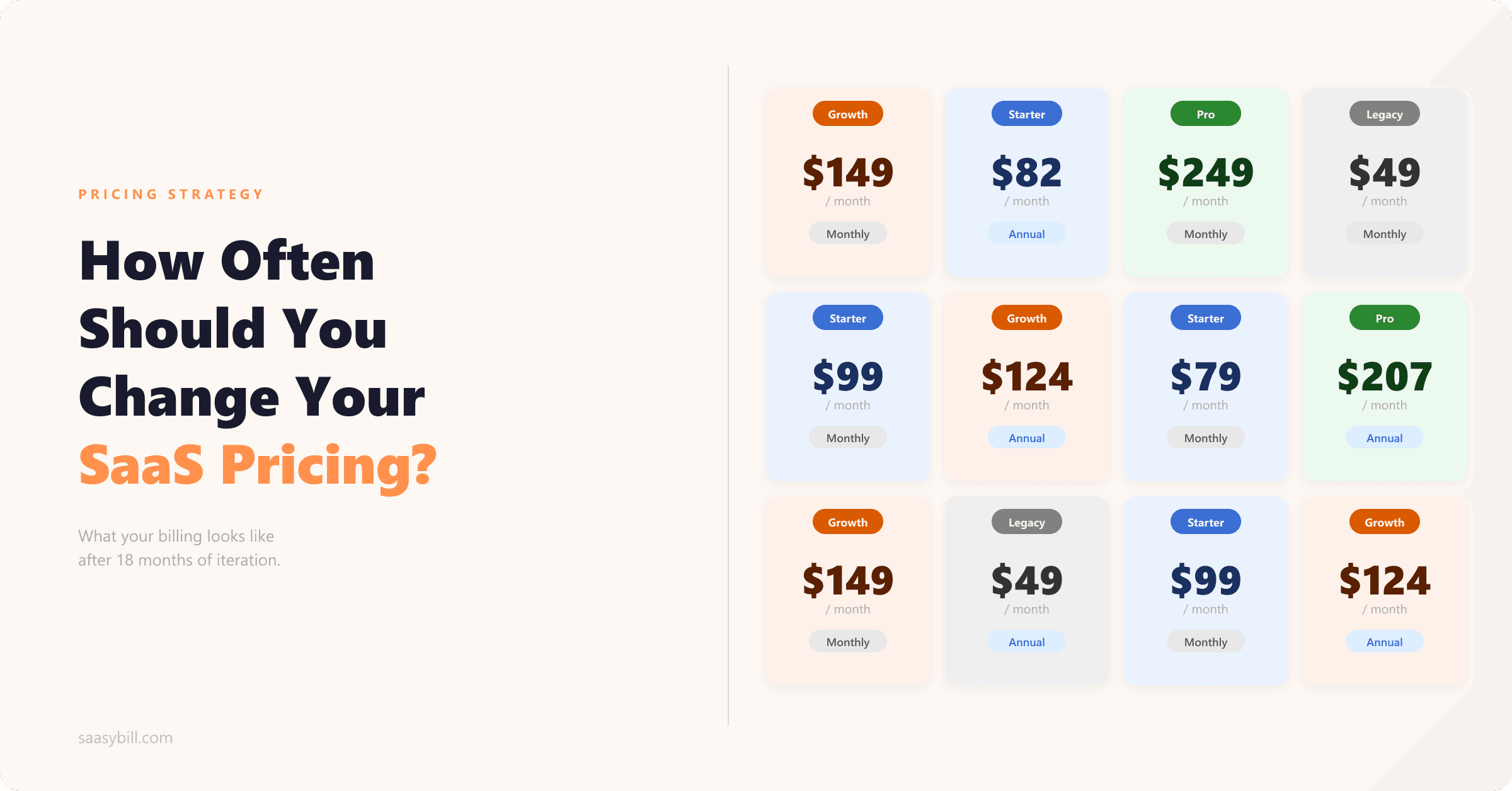
Most SaaS companies change their pricing far less often than they should. The typical pattern is a pricing decision at launch, an uncomfortable conversation about raising prices eighteen months later, and then another long silence. Meanwhile, the product has evolved, costs have changed, and customers have told you through their behaviour exactly how much they value what you're building.
The fastest-growing SaaS companies treat pricing differently. They iterate it. Not recklessly, but deliberately, and more often than most founders are comfortable with.
Why Founders Avoid Changing Pricing
The fear is usually about customer revolt. Raise prices and people cancel. Change plan structures and the support queue fills with angry emails. It feels like opening a door you can't close.
That fear is mostly unfounded, but there's a reason it persists: many founders have trained their customers to expect static pricing. If you haven't changed your pricing in three years, any change will feel like a shock. The companies that change pricing regularly don't face this problem, because customers already understand that pricing evolves alongside the product.
Basecamp has changed their pricing model more than once, and each time Jason Fried wrote about it publicly. Some customers pushed back. The company kept going, and most customers stayed. The friction was there each time, but it was manageable, and each change moved the business closer to a model that worked. Companies that treat pricing as fixed let that gap between price and value widen quietly, until closing it requires a jump large enough to cause even more backlash.
The same applies at much smaller scale. If you treat pricing as a living part of your product rather than a policy set in stone, customers will adjust their expectations accordingly.
What Pricing Iteration Actually Looks Like
Iterating your pricing doesn't mean constant chaos. It means having specific questions you're genuinely trying to answer, and treating pricing as a way to answer them.
Should you offer annual billing? Annual customers churn at roughly half the rate of monthly customers, and the upfront cash changes your cash flow picture significantly. If you haven't tried it, it's one of the highest-return experiments available. Are you leaving money on the table at the top end? If your most engaged customers are on your highest plan and still feel like they're getting more than they pay for, there may be headroom you're not using. Does your plan structure reflect how customers actually use the product? Plans designed at launch are based on assumptions. A year in, you know which features customers care about and which they ignore. That knowledge should inform how you package things.
One of the lowest-risk approaches is testing a new price point on new customers only, while grandfathering existing ones. You get real conversion data with minimal churn exposure. If the new price holds, you can migrate existing customers later with enough notice and clear communication about the change.
The Billing Reality That Makes This Hard
Here's where pricing iteration gets complicated in practice. Every change you make adds a layer to your customer base. Some customers are on your original plan. Some are on the new plan. Some are grandfathered at the old rate. Some are on annual, some monthly. You ran a promo six months ago and a handful of customers got 20% off for their first year. One customer negotiated a custom arrangement.
Eighteen months into iterating, you might have customers spread across six or eight different billing arrangements, all running simultaneously. This isn't a sign you've done something wrong. It's a normal consequence of building a product that evolves and a pricing model that evolves with it.
The problem is what this looks like operationally. If you're managing subscriptions through Xero repeating invoices or a spreadsheet, each of these arrangements is a manual record somewhere. When invoices go out, someone needs to verify that each customer has been charged the right amount for their specific plan, at their specific rate, for the right billing period. A customer upgrades mid-cycle and the proration needs to be calculated and added to the next invoice. Someone switches from monthly to annual and the billing date shifts. A plan price changes and you need to update every customer on that plan without accidentally touching the grandfathered ones.
The manual overhead compounds as your customer count grows. At 30 customers across three plan variants, it's manageable. At 80 customers across six billing arrangements, it becomes a meaningful source of errors and a task someone is quietly dreading each month.
The Infrastructure Question
This is the point where billing infrastructure either enables or prevents pricing iteration. If every plan change requires a developer, pricing decisions compete with the product roadmap. If it means manually auditing 80 customer records to make sure the right amounts go out, the incentive to leave things alone is strong.
The companies that iterate fastest have systems where the billing reflects the plan, automatically, for every customer. Customer on the legacy plan at the old rate? Correct invoice goes out without anyone touching it. Customer upgraded last week and owes a prorated amount for the remaining days? It's calculated and included. Mix of monthly and annual customers across three plan tiers? Each one gets the right invoice on the right date without a manual check.
For SaaS companies on Xero, Saasybill handles exactly this. It tracks which customer is on which plan, at which price, on which billing cycle, and creates the correct invoice in Xero each time. You can change a plan price, add an annual option, or update a specific customer's arrangement, and the billing follows without manual intervention. That's what makes pricing iteration practical rather than aspirational.
Start billing automatically in minutes.
Connect Xero, set up your plans, and have your first subscription running today. Every invoice lands directly in Xero.